

 By Mohd Khairy Abdullah
Editor-in-Residence
Pensiangan, Sabah
KOTA KINABALU, Oct 6, 2026 — Malaysia needs to rethink how schools identify and respond to students in emotional distress, a parent-teacher association leader said, calling for a major overhaul of school counselling services as concerns over youth mental health continue to grow.
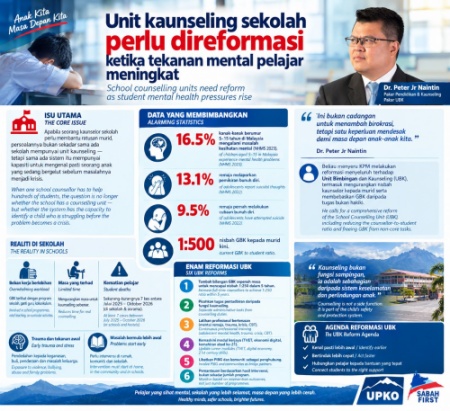
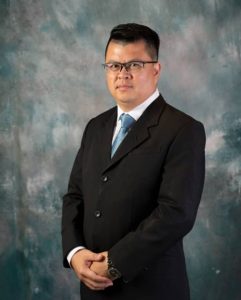
Dr Peter Jr Naintin said the Ministry of Education should strengthen School Guidance and Counselling Units, known as UBK, by reducing counsellor-to-student ratios, protecting counsellors from non-core duties and improving professional training.
The call comes amid growing evidence of mental health pressures among young people and reports of student deaths in schools and hostels nationwide.
Naintin, who has experience as a father, parent-teacher association leader and Chairman of a Hospital Visitors Board, said counselling should no longer be viewed as an auxiliary service but as part of the education system’s student protection framework.
Malaysia’s current counsellor-to-student ratio is about 1:500, a workload Naintin said makes sustained and meaningful intervention difficult.
The National Union of the Teaching Profession has called for the ratio to be improved to 1:350, while Naintin proposed a longer-term target of 1:250 within five years.
“How can a counsellor provide meaningful attention to 500 students when an effective counselling session requires time, trust and continuity?” he asked.
“This ratio is not merely a number. It determines whether our children receive the help they need, or are simply labelled and overlooked.”
Naintin said counsellors were also sometimes assigned school programmes, relief classes and co-curricular duties, reducing the time available for counselling and early intervention.
“It is unfair to expect GBK teachers to solve every social problem in schools without giving them sufficient space and resources,” he said.
The National Health and Morbidity Survey 2023 found that 16.5% of Malaysian children aged five to 15 had mental health problems, almost twice the level recorded in 2019.
The NHMS 2022 also reported suicidal thoughts among 13.1% of adolescents and suicide attempts among 9.5%, compared with 7.9% and 6.8% respectively in 2012.
The figures underline the scale of the challenge facing schools, where teachers and counsellors are often among the first adults outside the family to observe changes in a student’s behaviour and wellbeing.
At least seven student deaths were reported in schools and hostels nationwide between July 2025 and October 2026, according to the information cited by Naintin.
The cases involved different circumstances and remain subject to investigation. They should not automatically be attributed to bullying or any single factor.
But the deaths have intensified questions over whether schools have adequate systems to recognise warning signs and intervene before a student’s problems reach crisis point.
A recent study published in BMJ Open involving young people attending public psychiatry and mental health clinics in Malaysia found that 71% of 1,164 participants who completed the assessment reported a history of self-harm.
The study linked greater exposure to adverse childhood experiences with higher odds of self-harm, while coping capacity and perceived social support were associated with lower odds.
The findings should not be treated as a measure of self-harm prevalence among all Malaysian adolescents because the participants were drawn from psychiatric and mental health services.
But they point to the importance of early identification, support and intervention among vulnerable young people.
Naintin proposed six measures to strengthen school counselling.
They include gradually reducing the counsellor-to-student ratio to 1:250 within five years; expanding full-time counselling capacity; separating counselling from administrative and non-core duties; and strengthening continuous professional training in adolescent mental health, trauma, crisis counselling and evidence-based approaches such as cognitive behavioural therapy.
He also called for career guidance to be updated to reflect TVET, the digital economy and 21st-century skills.
Parent-teacher associations and communities, he said, should have a stronger role in connecting schools, families and public health services.
The effectiveness of counselling units should also be assessed through intervention outcomes rather than simply the number of programmes conducted.
For Naintin, the issue is ultimately about whether schools are equipped to act before a crisis becomes an emergency.
“The emergency department should not be the first place where the system discovers that a child is facing a problem,” he said.
The proposed reform is therefore not simply about adding more counsellors.
It is about creating a system capable of identifying distress earlier, responding faster and connecting students to appropriate support while there is still time to intervene.
In a modern education system, counselling is no longer an accessory.
And the measure of success should not be how many counselling programmes schools have conducted.
The more important question is whether the system can identify a child in difficulty before the crisis — and reach that child while there is still time to change the outcome.
