
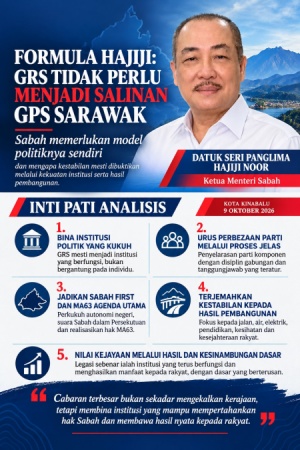
Hajiji Formula: GRS does not need to become a copy of Sarawak’s GPS
Why Sabah needs its own political model — and why stability must be demonstrated through strong institutions and tangible development outcomes


By Mohd Khairy Abdullah
Editor-in-Residence
Pensiangan, Sabah
KOTA KINABALU, October 11, 2026 — In Malaysian politics, the success of a state-based coalition is often measured by its ability to retain power, manage differences among political parties and build effective relations with the federal government. For Sabah, however, the more fundamental question is whether political stability can be translated into stronger institutions, more effective state autonomy and development that genuinely improves people’s lives.
This is where the strategic challenge facing Datuk Seri Hajiji Noor, Sabah Chief Minister and chairman of Gabungan Rakyat Sabah (GRS), comes into focus.
Hajiji has an opportunity to shape a Sabah political model rooted in local realities rather than simply replicate the success of Gabungan Parti Sarawak (GPS). But that opportunity will not be realised through party consolidation or a stronger leadership position alone. It requires the capacity to build political institutions that endure, function effectively and deliver results beyond the interests of individual leaders.
The question is not whether GRS can become like GPS. It is whether GRS can become an effective political institution designed around Sabah’s own needs.
GPS is often cited as a reference point in discussions about the rise of state-based political coalitions. Sarawak’s experience demonstrates the importance of coordinating local parties, developing a common agenda and leveraging the state’s political position in its dealings with the federal government.
Political success, however, cannot be separated from the historical and institutional context in which it emerges.
Sabah and Sarawak share several interests, including their position within the Malaysian Federation, claims relating to the Malaysia Agreement 1963 (MA63) and the need to strengthen their respective voices at the national level. Yet their political landscapes are not identical.
Academic analyses of the resurgence of regional political coalitions in Sabah and Sarawak suggest that Sabah operates in a more fragmented political environment, characterised by competition between local and national parties. This differs from Sarawak’s political structure, where a locally dominated coalition has established a stronger position.
The distinction carries a strategic implication: GPS can serve as a source of lessons, but its model cannot necessarily be transferred directly to Sabah.
GRS needs to identify what can be learned from Sarawak’s experience — including coalition discipline, policy coordination and leadership continuity — while developing its own solutions to Sabah’s political challenges.
Copying a structure without understanding its context produces only superficial similarities. Building institutions around local realities, by contrast, creates the conditions for more authentic political capacity.
Hajiji occupies a strategic position from which he can influence the direction of GRS’s political development. As Chief Minister and coalition chairman, he stands at the intersection of government administration, coordination among component parties and the formulation of the state’s agenda.
Leadership of this kind can serve as a unifying force within a coalition comprising parties with different backgrounds, interests and support bases.
Yet a leader who successfully unites a coalition has not necessarily succeeded in building an institution.
That distinction matters. Personal leadership can help defuse conflicts and accelerate decisions. Institutions, meanwhile, ensure that decisions follow established processes, responsibilities are clearly defined and policies continue even when leadership changes.
The true measure of Hajiji’s effectiveness, therefore, is not simply how long he can maintain government stability. The deeper measure is the extent to which he can build a political system that functions without relying entirely on his personal influence.
In this sense, the description of Hajiji as an architect of modern Sabah politics should be regarded as a possibility to be demonstrated through institution-building, rather than an accolade to be conferred in advance.
The strongest political legacy is not a coalition that survives only under one leader, but an institution that continues to function effectively after that leader steps aside.
Political scientist Samuel P. Huntington, in his seminal work Political Order in Changing Societies (1968), emphasised the importance of political institutional development in establishing stable political order.
This framework offers a useful perspective for assessing GRS’s future.
Political institutionalisation refers to the process through which political organisations and procedures become more established, acquire value and significance beyond individual interests, and develop the capacity to function consistently. It involves more than the existence of an organisational structure; it requires that the structure be capable of managing change and conflict effectively.
For GRS, this principle can be tested through at least four questions.
First, does the coalition have clear decision-making mechanisms that all component parties respect?
Second, can competing interests be resolved through institutional processes rather than relying almost entirely on personal negotiations between leaders?
Third, does GRS have a system for developing future leaders and ensuring policy continuity?
Fourth, can the coalition translate political decisions into government policies that are consistent, implementable and measurable in terms of results?
If the answers increasingly become positive, GRS will be moving beyond a coalition that manages political power towards becoming a political institution.
Conversely, if stability depends primarily on a temporary balance among influential figures and parties, the coalition will remain vulnerable to shifting interests, internal competition and leadership uncertainty.
The acceptance of the United Progressive Kinabalu Organisation (UPKO) as a component party of GRS on June 18, 2026, opened a new chapter in the coalition’s political development. GRS chairman Hajiji described the move as a step towards strengthening local parties and stabilising the state government.
UPKO president Datuk Ewon Benedick, meanwhile, has advanced an agenda emphasising Sabah’s interests, including the pursuit of MA63-related demands and the state’s constitutional rights.
This development gives GRS an opportunity to broaden local political cooperation and align the Sabah First agenda with state development policies. However, UPKO’s strategic value should not be measured merely by the addition of another party to the coalition.
The more important question is what UPKO can contribute to the quality of GRS’s politics and governance.
UPKO has the potential to act as a catalyst by strengthening policy debate, broadening political participation and ensuring that Sabah’s rights remain part of a clear and actionable agenda. Its experience and political identity could add value to the coalition if differences of opinion are managed maturely and constructively.
But potential is not the same as demonstrated results.
To become a genuine additional source of strength, UPKO must demonstrate measurable contributions to decision-making, economic development, the strengthening of local enterprises, the implementation of the MA63 agenda and improvements in public well-being.
At the same time, GRS must ensure that the entry of a new party represents more than an expansion of membership. It should form part of a broader effort to strengthen institutional capacity.
In other words, UPKO’s participation becomes a strategic advantage only if it improves the quality of the coalition — not merely its size or political position.
Sabah First has the potential to provide the foundation for a more coherent local political model. But a powerful slogan does not automatically translate into effective negotiating power.
State-level political leverage requires a coalition with a clear policy position, the capacity to coordinate competing internal interests and the determination to pursue the implementation of constitutional commitments.
MA63 and Sabah’s rights should not be used merely as symbols of political unity. They require an approach grounded in law, intergovernmental negotiations, administrative capacity and transparent assessments of progress.
These issues include revenue sharing, autonomy in areas of state jurisdiction, infrastructure development and disparities in access to basic amenities between urban and rural communities.
For people in Sabah’s interior, political success is not measured solely by government stability or the strength of a coalition. It is also judged by access to roads, water, electricity, education, healthcare, employment opportunities and the capacity of local economies to grow.
Sabah First must therefore evolve from a political principle into a policy framework with clear priorities, targets and implementation mechanisms.
If GRS can align the pursuit of state rights with measurable development outcomes, it will have an opportunity to establish a stronger foundation of political legitimacy.
A serious analysis must also acknowledge that building a distinct Sabah political model is not without risks.
First, the interests of component parties may diverge, particularly over representation, the allocation of responsibilities and the setting of policy priorities. Without effective mechanisms for resolving disagreements, these differences could weaken coalition unity.
Second, political negotiations that are excessively centred on individual leaders can leave institutions less capable of managing change. This increases the risks associated with leadership transitions or shifts in the balance of power.
Third, political stability can lose its meaning if it is not accompanied by improved administrative performance. A stable government must still demonstrate its effectiveness through public services, economic development and responsible resource management.
Fourth, Sabah’s demands must be supported by a consistent, evidence-based negotiating strategy. Forceful rhetoric may attract attention, but long-term progress requires technical expertise, coordination across agencies and a sustained commitment to implementing decisions.
These risks are not reasons to reject GRS or Hajiji’s leadership. Rather, they demonstrate why the coalition needs institutions that are more robust than a political understanding among its leaders.
If GRS wants to demonstrate that it can develop its own political model, its performance must be assessed against observable criteria.
First, institutional strength. Are decision-making processes, conflict management and leadership development becoming more structured and effective?
Second, policy continuity. Are state development priorities being pursued through clear targets, implementation plans and evaluation mechanisms?
Third, development outcomes. Is political stability accompanied by better access to basic amenities, greater economic opportunities and improved public services, including in Sabah’s interior?
Fourth, progress on Sabah’s rights. Is there documented and measurable progress on MA63-related demands and the state’s constitutional rights?
Fifth, leadership resilience. Is GRS developing future leaders and institutional mechanisms that allow the coalition to function effectively without excessive dependence on one individual?
These measures matter because they distinguish the management of political power from the building of lasting institutions. They also allow supporters, critics and researchers to assess GRS’s performance against the same criteria.
Hajiji has an opportunity to shape a new phase in Sabah’s political development. But that opportunity depends on his ability to transform coalition stability into institutional strength, and to turn the Sabah First principle into tangible development outcomes and measurable policy progress.
GRS does not need to become Sarawak’s GPS to succeed. Instead, it must understand why Sarawak’s political model works within its own context, identify the lessons that are relevant and build structures suited to Sabah’s realities.
In this process, UPKO can become an additional source of strength if its participation improves policy quality, broadens local political cooperation and enhances GRS’s capacity to advance the state’s interests.
However, the coalition’s future cannot rest on the assumption that adding parties automatically produces stability, or that stability automatically delivers progress.
Hajiji’s greatest challenge is not simply to keep the government in power. It is to build political institutions capable of reconciling competing interests, defending Sabah’s rights and delivering development that people can actually experience.
If GRS succeeds, it will not need to become a copy of GPS to be considered successful. It will have something more valuable: a political model shaped by Sabah’s own experience, judged by its performance and capable of enduring beyond the leadership of any one individual.
That is the true measure of a political legacy — not merely who leads, but what institutions are left behind and what kind of future is built for the people of Sabah.
