
Arthur: RM1.5 Billion Interim Payment Not Final Settlement on Sabah’s 40% Claim
The MA63 agenda also includes strengthening Sabah and Sarawak’s representation in the Dewan Rakyat.

By Mohd Khairy Abdullah
Editor-in-Residence
Pensiangan, Sabah
SOOK (Pensiangan), Sept 12 — The RM1.5 billion interim payment to Sabah is a positive development in addressing the state’s financial rights, but it should not be regarded as a final settlement of Sabah’s claim to 40 per cent of its net revenue under the Federal Constitution, P.182 Pensiangan Member of Parliament Datuk Seri Arthur Joseph Kurup said.
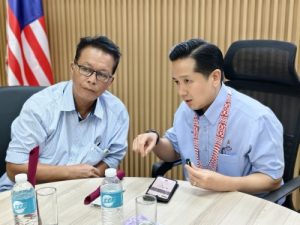
In an exclusive interview in Sook on Saturday, Arthur said the increase in the special payment should be welcomed as a step forward, but Sabah’s position on its 40 per cent constitutional entitlement remained unchanged.
“This is only an interim payment. It is not a settlement of the 40 per cent claim,” he said.
The Federal Government had agreed to immediately increase the special payment to Sabah to RM1.5 billion as an interim measure while negotiations on a new formula for the payment continue.
Prime Minister Datuk Seri Anwar Ibrahim said in Sabah on Friday that the amount was expected to be channelled this year after the relevant paper is tabled in Parliament in October, with payment expected to be made by the end of October or early November at the latest.
Anwar said the Government would have to take into account the country’s financial position when determining the new formula, including setting reasonable minimum and maximum amounts.
“For that reason, I have agreed to immediately increase it from this year to RM1.5 billion as an interim measure,” he said.
For Arthur, the increase remained a positive development, but Sabah’s acceptance of the interim payment did not mean the state had accepted or was satisfied with the settlement.
“Our position remains that we are entitled to our rights under the Federal Constitution, namely 40 per cent,” he said.
Arthur said the RM1.5 billion payment should therefore be viewed as an interim measure, rather than a substitute for Sabah’s 40 per cent entitlement under the constitutional framework and the Malaysia Agreement 1963 (MA63).
On another issue, Arthur said the MA63 agenda extended beyond financial rights to include the position and representation of Sabah and Sarawak in the Dewan Rakyat.
He said the representation ratio at the time Malaysia was formed in 1963 had changed following Singapore’s departure from the Federation.
The relative share of seats held by Sabah and Sarawak is now about 25 to 27 per cent, compared with the ratio at the formation of Malaysia, he said.
Arthur said he had consistently raised the issue in the Dewan Rakyat since 2018 and continued to pursue it after joining the Federal Cabinet.
The latest development, he said, came during a meeting of the MA63 Action Council, chaired by the Prime Minister, where there was agreement to study efforts to increase the number of representatives from Sabah and Sarawak in the Dewan Rakyat.
“We need to restore and increase the number of representatives from Sabah and Sarawak so that it more accurately reflects our role in the Federation of Malaysia,” he said.
The effort would involve a delimitation review and discussions with the Election Commission (EC), he said.
In the context of Pensiangan, Arthur said any new delimitation and representation should not be determined solely by the geographical size of a constituency.
Several factors would need to be assessed comprehensively, including population, access to polling centres, as well as the economic potential and activity of an area, he said.
“If an area is very large but its population remains small, it may not yet qualify. We also need to look at access to polling centres and the economic generation of the area,” he said.
These factors, he added, would form part of the considerations when a new delimitation review is undertaken.
The issue is particularly significant for Pensiangan, which covers a vast geographical area and faces distinctive challenges in terms of access and development in its interior communities.
Arthur said the issues of the special payment and political representation illustrated at least two key dimensions of the MA63 struggle — financial rights and political voice.
The RM1.5 billion interim payment provides Sabah with additional resources in the short term, but negotiations on a new formula for the special payment remain ongoing.
At the same time, the proposed review of the number of seats held by Sabah and Sarawak in the Dewan Rakyat raises a broader question of political representation and whether the parliamentary structure adequately reflects the position of both territories within the Federation of Malaysia.
Arthur said both issues needed to be pursued continuously, without treating any single positive development as a complete resolution of Sabah’s wider claims.
For Pensiangan, he said, representation should be assessed against realities on the ground, including population, geographical size, access to polling centres and economic potential.
Such an approach, he said, was important to ensure that any future changes to electoral boundaries would produce a more effective system of representation capable of reflecting the voice and needs of the people more accurately.
