


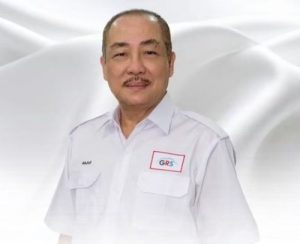
By Mohd Khairy Abdullah
Journalist | Kudat, Sabah
KUDAT, October 18 — The Gabungan Rakyat Sabah (GRS) coalition must put Sabah’s interests first and strengthen internal unity by setting aside political ego and narrow party or individual interests to safeguard the state’s political stability and strengthen its bargaining position at the federal level.
Sabah Chief Minister Datuk Seri Panglima Haji Hajiji Haji Noor said the state’s political strength depended on the ability of GRS component parties to maintain unity, avoid internal disputes and place collective interests above competition among themselves.
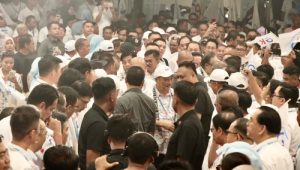 “There is no point praising the unity of others if we are still fighting among ourselves within GRS. Sabah’s strength begins here, with our own strength,” he said in his keynote address at the 2026 GRS Convention at Dewan Tun Mustapha, Kudat, on October 18.
Hajiji, who is also GRS chairman, said the coalition was established in 2020 in response to the people’s aspirations for a strong local political force capable of determining Sabah’s future, defending the people’s interests and ensuring stable state administration.
He said GRS’s success in emerging as the largest bloc in Sabah’s 17th State Election (PRN) in November last year was not the achievement of any single party or leader, but the collective contribution of all component parties, leaders and members of the coalition.
“No party is so big that it no longer needs its partners. And no party is so small that its contribution can be ignored. Everyone has a role to play,” he said.
Hajiji stressed that GRS’s collective interests must take precedence over those of any individual component party, while Sabah’s interests must, in turn, take precedence over the interests of GRS itself.
He said this principle was essential to ensuring that the coalition remained focused on the people’s welfare and the state’s future rather than the political interests of particular groups.
Hajiji also expressed appreciation for grassroots members who had sacrificed their time, energy and personal funds during election campaigns, including using their own vehicles and leaving their families behind for the sake of the party.
He said these individuals, many of whom received little media attention and were not widely known, formed the foundation of GRS’s strength. Their contributions, he stressed, must never be forgotten when victories were achieved.
“These are the people who truly form the foundation of GRS’s strength. Those of us standing on this stage are here because many people below us and out there have helped and supported us to reach our present positions. Therefore, we must never forget them,” he said.
Hajiji said the decision by certain parties to leave the coalition and pursue their own paths should serve as a lesson, prompting GRS to strengthen unity, demonstrate greater maturity in decision-making and set aside political ego.
He said Sabah’s diverse society and the differing choices of its voters must be understood and respected, while the coalition’s organisational capacity and cooperation among component parties must continue to be strengthened to maintain public confidence.
Hajiji said the people were not satisfied with political rhetoric alone. They wanted better living conditions, employment opportunities, a stronger economy and a stable government capable of resolving their problems.
“The people want a stable government that does not merely talk but is capable of solving problems. We may win applause through speeches on stage, but still lose the battle to win the people’s hearts,” he said.
He stressed that being a local political party was not, in itself, sufficient to secure public confidence. Trust had to be earned through effective administration and development outcomes that people could genuinely experience in their daily lives.
Looking ahead to the next election, Hajiji said discussions over candidates and seat allocation would inevitably test the loyalty and spirit of solidarity among component parties, particularly when some were required to compromise or accept decisions that did not meet their expectations.
He urged leaders to distinguish between defending principles and defending personal ego. Failure to secure an electoral seat, he said, must not become an excuse to sulk, refuse cooperation or attack fellow coalition partners.
GRS candidates were also cautioned against becoming arrogant after winning, as their victories depended on the support of campaign machinery from multiple component parties, including those that were not given the opportunity to contest.
“No GRS candidate wins alone! Behind every victory is a campaign machinery supported by various parties. Remember, politics is always changing. We may be strong today, but tomorrow is not guaranteed,” he said.
Hajiji said relations within GRS must be built on trust and mutual respect. At the same time, younger generations must be given opportunities to assume responsibility and contribute fresh ideas, while the experience of veteran leaders should continue to be valued to ensure continuity in the coalition’s political struggle.
He also reminded leaders that political positions were not permanent. Every leader held office as a temporary trust and should not become so attached to their position that they neglected their responsibilities to the people.
“That is why we must not become so attached to our seats that we forget why they were entrusted to us in the first place,” he said.
Hajiji stressed that GRS’s four guiding principles — Sabah First, Sabah United, Sabah Forward and Sabah Prosper — must be demonstrated through commitment, concrete action and sustained efforts to safeguard the people’s welfare, rather than being reduced to political slogans.
