
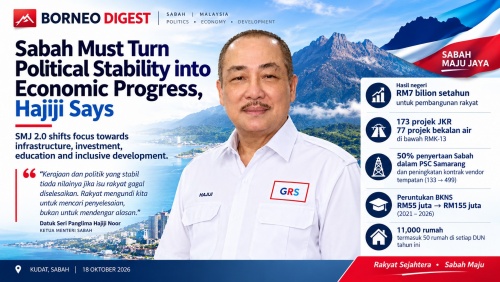
Sabah must turn political stability into economic progress, Hajiji says
SMJ 2.0 shifts focus towards infrastructure, investment, education and inclusive development

By Mohd Khairy Abdullah
Journalist | Editor-in-Residence
KUDAT, SABAH | 19 October 2026
SABAH must translate political stability and stronger state finances into tangible improvements in living standards, infrastructure and economic opportunities as the state prepares to enter a new phase of development under the Sabah Maju Jaya (SMJ) 2.0 roadmap, Chief Minister Hajiji Noor said.
Speaking at the Gabungan Rakyat Sabah (GRS) 2026 convention at Dewan Tun Mustapha in Kudat on October 18, Hajiji, who chairs the ruling coalition, said his administration’s first five years had focused on stabilising politics, strengthening public finances, improving governance, attracting investment, pursuing Sabah’s rights and reviving delayed projects.
The next phase, he said, must use that stability to attract investment, build infrastructure and shape Sabah’s development over the next 10 to 20 years.
“Kerajaan dan politik yang stabil tiada nilainya jika isu rakyat gagal diselesaikan. Rakyat mengundi kita untuk mencari penyelesaian, bukan untuk mendengar alasan,” he said.
The message sets a clear test for SMJ 2.0: political stability must deliver measurable development, rather than remain an achievement in itself.
Hajiji said Sabah’s annual revenue had reached RM7 billion, stressing that the increase should benefit the public through development, economic opportunities and education.
Yet water supply, roads and electricity remain key challenges. Under the 13th Malaysia Plan (RMK-13), the state is implementing 173 Public Works Department projects and 77 water-related projects, covering roads, bridges, treatment plants and water supply systems.
Hajiji acknowledged that projects require time for design, land acquisition, tendering and construction, but said the government would continue working to resolve long-standing problems.
From an economic policy perspective, the challenge is to turn higher revenue and project allocations into reliable public services. The number of projects matters, but their completion, quality and direct impact on communities will be equally important measures of progress.
Sabah’s rights under the Malaysia Agreement 1963 (MA63), including its economic entitlements, remain a priority, Hajiji said. The state is pursuing negotiations with the federal government using financial data, legal arguments and technical preparation.
“Yang penting, Sabah mendapat hasil. Yang sudah muktamad, kita laksanakan; dan yang masih interim, kita usahakan sehingga dimuktamadkan,” he said.
In oil and gas, Hajiji described the 2021 Commercial Collaboration Agreement with PETRONAS as an important step towards greater state participation.
Through SMJ Energy, Sabah holds a 50% participating interest in the Samarang Production Sharing Contract (PSC), alongside participation in oil, liquefied natural gas and petrochemicals.
Local vendor contracts rose from 133 in 2021 to 499 in 2025, he said.
The broader economic objective, Hajiji said, is to ensure that Sabah gains not only revenue from natural resources but also business opportunities, local expertise, ownership and downstream industrial activity.
For the state, the long-term test is whether greater participation in the sector strengthens local businesses and expands the share of economic value retained within Sabah.
Hajiji said the state continued 14 education assistance initiatives, including BUDI, Bantuan Ihsan Komputer (BAIK) and student air travel assistance under SUBFLY.
The Sabah State Government Scholarship allocation increased from RM55 million in 2021 to RM155 million in 2026, while nearly 480,000 students had benefited from various forms of educational assistance or incentives, he said.
The government is also continuing the Sentuhan Kasih Rakyat (SYUKUR) programme and Rumah Mesra Sabah Maju Jaya initiative. A total of 11,000 houses have been completed or are under construction, Hajiji said. This year, the state is continuing construction of 50 homes in each state assembly constituency to assist poor and hardcore poor households, as well as young couples from low-income families without homes.
Hajiji linked his commitment to education to his own childhood experience, recalling that his mother had to borrow RM15 from relatives to pay his examination fees in 1971.
He said poverty should not determine a young person’s future before they have the opportunity to succeed.
Sabah’s next development phase will depend on whether stronger public finances, greater participation in strategic industries and expanded social assistance translate into lasting improvements in people’s lives.
For policymakers and economists, the central issue is implementation: whether infrastructure projects resolve basic service gaps, education spending strengthens human capital, and participation in the oil and gas industry creates wider opportunities for local businesses.
Hajiji has positioned political stability as the foundation for that transition. The challenge now is to demonstrate that stability can deliver tangible and broadly shared economic gains, particularly for communities in rural and interior Sabah.
