

By Mohd Khairy Abdullah
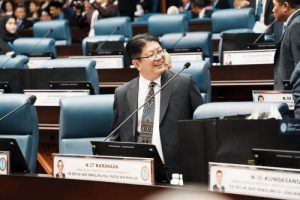
KOTA KINABALU, 30 April 2026 – Sabah is accelerating its economic transformation agenda at a time of intensifying competition for investment and supply chain positioning across Borneo and the wider Asia-Pacific region, with a strong focus on strengthening industry, entrepreneurship, and the state’s logistics ecosystem.
Under the portfolio of Industrial Development, Entrepreneurship and Transport, Datuk Ewon Benedick is driving a more structured development approach that goes beyond growth targets, placing equal emphasis on building internal economic capacity and reducing long-term dependency on external drivers.
This signals a gradual shift from a conventional development model towards a “value-chain driven economy”, where Sabah aims not only to attract investment but to embed itself more firmly within regional industrial value chains.
Commercial and industrial projects led by SEDCO in Pulau Bum-Bum, Matunggong, Weston, and Beaufort reflect an effort to decentralise economic growth and expand opportunities into rural areas.
However, the sustainability of this strategy hinges on critical factors such as infrastructure readiness, market access, and the ability to attract sustained private-sector participation in traditionally less competitive locations.
The expansion into Sook and Kota Kinabatangan is seen as a strategic attempt to open new economic corridors in interior regions, though its success will depend heavily on logistics connectivity and effective market integration.
The establishment of the Business Incubator Centre in Penampang, alongside the Tunas Niaga programme involving approximately 1,000 students across Sabah, reflects a long-term effort to cultivate a new generation of entrepreneurs.
The key question, however, lies in scale and impact—whether these initiatives can produce enterprises that grow beyond government-supported ecosystems.
Efforts in training, halal certification, and SME capacity building are important steps, but their effectiveness ultimately depends on access to financing, markets, and export readiness.
Developments at the Kota Kinabalu Industrial Park (KKIP), POIC Lahad Datu, and the Sipitang Oil and Gas Industrial Park (SOGIP) highlight Sabah’s ambition to strengthen its position in downstream industries and the energy sector.
Projects such as the Ready Built Factory (RBF6) at KKIP, the development of a free zone in Lahad Datu, and the expansion of palm biomass industries reflect a clear strategy to increase value addition within commodity-based sectors.
Nonetheless, structural challenges remain significant, including high logistics costs, limited skilled labour supply, and competition from more mature industrial hubs in neighbouring regions.
Transport and logistics have emerged as a key constraint to Sabah’s industrial ambitions.
Immediate measures to ease congestion at Sepanggar Port, including eight interim initiatives covering container management and vehicle booking systems, indicate a pragmatic response to operational inefficiencies that have long affected trade competitiveness.
In the longer term, proposed rail development linking Putatan–KKIP–Sepanggar, along with additional locomotives for the Sabah State Railway Department, signals recognition that industrial transformation cannot proceed without integrated land–sea transport reform.
Overall, the policy direction led by Datuk Ewon Benedick reflects a more systematic framework for strengthening Sabah’s economic foundations over the long term.
However, as with most regional transformation agendas, the real test lies in execution—particularly in bureaucratic efficiency, investment continuity, and the ability to sustain momentum in strategic projects.
Against the backdrop of increasingly aggressive regional investment competition, Sabah is now at a critical juncture: whether it successfully transitions into a higher value-added economy, or remains constrained by longstanding structural limitations that continue to cap its potential.
